Friday, October 28, 2011
A quote from Prof. Amarthya Sen

Tuesday, August 9, 2011
'Resistance' Managaement
Recently, Government of India issued an order to ban plastic carry bags whose thickness is less than 40 microns. Greater Hyderabad Municipal Corporation (GHMC) was very keen on implementing it. Expecting the resistance from the plastic manufacturing units, GHMC officials strategically announced that they are planning to ban plastic carry bags completely irrespective of thickness. But technically, the power of banning of plastic is reserved with the Union environment ministry and GHMC Act doesn’t have any power to ban plastic except to implement the Government of India orders relating to it. GHMC officials deliberately passed the information to media that they are planning for complete ban on plastic carry bags. As expected by GHMC officials resistance came from political parties and industrial units, and they staged protests to not to ban plastic carry bags. After few days, GHMC announced only those plastic products are banned whose thickness is below 40 microns. Political parties and industrial units were pacified because their resistance had an impact on the final outcome. In this way, GHMC is managed to implement the plastic ban without any resistance to its actual policy.
Saturday, July 16, 2011
Mind Blowing Questions!
Question No. 1
Swathi is taller than Swetha. Shalini is shorter than Vaishali. Keerthi is taller than Swathi. If Vaishali’s height is 5”3”. Who is tallest?
Option 1: Keerthi
Option 2: Swathi
Option 3: Vaishali
Option 4: Shalini
Question No. 2
The area of the shaded region in the figure if ABCD is a square of length each side 14 cm
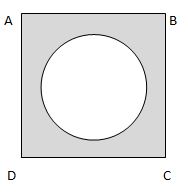 Option 1: 42 Sq cm
Option 2: 100 Sq.cm
Option 3: 154 Sq.cm
Option 4 : 196 Sq.cm
Question No.3
P, Q, R and S are playing a game of carom. P, R and S, Q are the partners. S is to the right of R. In which direction Q is facing
Option 1: South
Option 2: East
Option 3: West
Option 4: North
Friday, July 1, 2011
The saga of subsidies
The budget introduced by Finance Minister for 2011-12 shows 9 percent of central budget is allotted to subsidies, which accounts to 1.43 lakh crore rupees. However, the expenditure on subsidies mentioned in the budget is only explicit portion of central government subsidies. It doesn’t include the implicit subsidies like tax exceptions to SEZ’s, land acquired by the government for industrial purposes, etc. And also, subsidies mentioned in the budget only related to Central subsidies, it doesn’t include the states explicit and implicit expenditure on subsidies. So the amount of subsidies in India is colossal than on paper.
Subsidy is a benefit given by the government to individual or group usually in the form of cash payment or tax reduction. Subsidy is often considered to be in the interest of the public. Cash subsidies, Interest or credit subsidies, tax subsidies, in kind subsidies, procurement subsidies, regulatory subsidies are forms by which government is providing subsidies to individual consumers. Protection of the vulnerable sections is the main intention of government to provide subsidies to individuals. The state has been using subsidies as an important tool in its operational administration. It is quite debatable whether these subsidies are reaching the target section or not. Think tankers thrive to formulate populist policies resulted in inclusion of major part of the population in the subsidy purview, which ultimately increased the weight of subsidies. After implementing the subsidy strategy for decades, people are used to the subsidies, and now it seems, citizens are expecting the subsidies as a matter of right. In the process of changing the role of Government in Indian economy from the driver to a facilitator, Government is keen on reducing the subsidy weight from its expenditure without harming the poor.Approximately, 90 percent of the total explicit subsidies accounts to food, petroleum and fertilizer subsidies. Obviously, if explicit subsidies have to be reduced, then steps have to be taken to limit these three subsidies. Minimum support price, public distribution system, food procurement and maintaining buffer stocks are important components of food subsidies. Purchase of food grains at minimum support price from farmers by government, without any limit has resulted in the creation of buffer stocks in excess of its storage capacity. There are substantial leakages of food grains in public distribution system. For all these years, the state has been succumbing to farm lobby pressures, thereby responding by raising minimum support price and also undertaking unlimited procurement. Kerosene and LPG subsidies accounts major part of petroleum subsidies. According to a government report, about half the subsidized kerosene supplies diverted and never reaching intended groups. Different approach has been adopted for fertilizer subsidy, where the subsidy amount is paid to industry than government. The most contentious issue surrounding fertilizer subsidies in India is how much of what is paid out actually finds its way into the pocket of the farmer, and how much is siphoned away by the fertilizer companies. Overall, there is substantial scope for improvement in the system and reducing subsidy weight of the government. In this year budget speech, finance minister has announced that government is considering direct cash subsidy on kerosene and fertilizers to genuine beneficiaries.
Subsidies can be reduced if Government has the political will to undertake hard decisions. However, coalition governments which try to appease various social groups find it extremely difficult to do so. The political economy of subsidies prevents the government not to go ahead with a policy of reduction of subsidies. One side, central government keen on reducing the subsidy and other side states are coming up with a plethora of subsidy policies shows, lack of integrated planning between center and states to curb the irregularities and reducing the subsidy expenditure. There is large gap between policy and practice. Government subsidies are meant for protecting the poor and government subsidy policies should be reinforced in such a way that they should reach only to the right beneficiaries. But, to do this, Government requires great amount of courage.
Sunday, February 20, 2011
Women Reservations: A Pending Issue
In 1996, Government of India introduced women reservation bill in the parliament, but failed to convert it to an Act. Later several attempts made by successive governments, but they failed to achieve consensus among the political parties. Last year, Ruling party with the support of the major opposition party, women reservation bill was passed in Rajya Sabha. After that, bill was supposed to introduce in Lok Sabha but due to some political strategies of respective parties, bill was not introduced.
Political power is an important element in Women empowerment. Women reservation is a tool to access the political power for women. It will give adequate opportunities to underprivileged women to be part of the government and policy making. At present, in India, the talent pool of politicians is often from men, but women reservation will widen the catchment area. It will enhance the administration abilities of women and in turn the administration itself. For instance, after reservations, significant positive changes were observed in rural and urban local bodies, where women were representing. Many countries are already providing women reservations and registered impressive gains. Women reservations give an opportunity to women to raise their voice on their problems, concerns and demands. In the long term, it will enhance the position of women in our society.
There may be few disputable issues associated with the bill like rotational basis of allotment of seats, creamy layer issue etc. This bill may not be the best or only solution to empowerment of women. However, let not the perfect be the enemy of the good.
Saturday, February 5, 2011
Food Security
However, Rangarajan committee differs with the NAC recommendation on Food Security and concluded that it may not be feasible to implement the bill in its current form. Three major aspects were the bone of contention, First, production rate and procurement of food grains, as per the report, the food grains required to implement the food security is about 69 million tons but the current expected rate of production will be about 56 million tons. Second, negative impact on market prices and effect on vulnerable sections like middle class families. Third, burden on exchequer and consequences.
Food security is essential for our country to address dietary needs of the population. But, the draft bill deals food security in a narrow view, whereas, it actually has wider scope. Food security has three important elements, food availability, food access and food use. The draft food security bill prominently deals with food access and very little about other two. Food availability includes production, diversifying the food pattern in order to get appropriate nutrient diet, understanding the future needs and planning accordingly, etc. The major concern for India is too much dependency on certain crops and varieties like Rice and wheat, which ultimately resulting in high demand and pressure on those crops. India should plan in such a way that the productions of other food grains like Jowar, Bajra, Finger millet, etc. should be encouraged. Through this not only pressure on the main food grains will decrease, but also helps to increase the nutritional levels of population. Food use, it includes using food resources of the country in a sustainable and optimum manner. For example, India has about 7000 kilometers coastal line, but still, sea food in Indian diet is negligible. Food access means not only providing food grains for subsidised prices but also to meet the consumption demands of the population. Subsidised food is short term strategy; policy makers should also concentrate on long term strategies to meet the consumption demands.
I think, Rangarajan committee has rightly recommended that subsidized food grains shall be given to only BPL families (46% rural and 28% urban population) instead of 75% of the population. However, subsidised food grains and proper distribution alone are not food security. Food security is about production and availability of food grains according to the needs of population. It is unfortunate that Indian think tank is more concerned about populist policies than policies for India.
Saturday, January 1, 2011
Parliament Logjam
Recently, Joint Parliamentary Committee (JPC) became the focal point in the parliament sessions. The issue started with Opposition parties demanding for JPC probe in 2G spectrum allocation, which led to loss of Rs. 1.76 crores to Government(as per CAG report). However, Government insists that JPC probe is not necessary, since PAC (Public Accounts Committee) is looking into the matter. These different stands resulted in 23-day parliament logjam.
PAC was established in 1921 by British rulers, which subsequently continued after independence. PAC consists of 22 members (15 from Lower House and 7 from Upper House). The members are elected by the Parliament every year from amongst its members according to the principle of proportional representation by means of the single transferable vote. The function of Committee is to examine the annual audit reports of the Comptroller and Auditor General of India (CAG) which are laid before the Parliament by the President. In this function, Committee is assisted by the CAG.
Joint Parliamentary Committee is an ad hoc committee, which is constituted to probe into a specific subject. It consists of members from both houses. The JPC can take oral and written evidence or call for documents in connection with a matter under its consideration. Generally, the proceedings of parliamentary committees are confidential but in case of JPC, it can brief the proceedings to press, considering the 'widespread public interest' in the matter. Until now, four JPC's were constituted. Though, PAC and JPC, both functions are almost similar, the reason for Opposition parties demanding for JPC probe into 2G spectrum matter is to keep the heat on government through continuous reporting of proceedings. However, the Government doesn't want to constitute JPC because new problems will come every time when JPC briefs the press.
The stubborn attitude of Government and Opposition in their respective stances resulted in wastage of Rs171 crores. Interestingly, more than to find out the truth in the 2G spectrum scam, opposition parties are playing political games in order to have the cream out of it. Opposition demanding for JPC is a good move but interrupting the sessions regularly and not discussing other crucial issues in the parliament is not good for parliamentary system. Opposition must have used other methods to pressurize the Government, instead of wasting the precious time of parliament. Government also not acted in a responsible manner when whole winter sessions were completed without opposition parties in both the houses. There should not be any excuse to constitute a JPC, if the Government (especially ministers) is not done any irregularities in 2G spectrum allocations.
By this kind of parliamentary logjam, both the sides i.e. Government and Oppositions are safe for now and the loser is the citizen of India.
Thursday, December 2, 2010
Food Coupons for Punctuality
A leading Indian public sector insurance company introduced a new policy to benefit its employees. The new policy aims at encouraging its employees to come on time to the office. As per the policy, employees get food coupons worth of an amount ranging Rs 50 to Rs 200 daily, if they come to the office at 10 AM (with ten-minute grace times). For this purpose, employees have to sign in to the computers, as soon as they enter the office. This provision is apart from employee's regular salary.
Administration point of view, 'Food coupons for punctuality' policy raised five important questions:
- Is it fair to give food coupons for punctuality, whereas, punctuality is an ethical responsibility of the employee?
- Is it providing a kind of facility to the employees to come late to the office?
- Will this policy truly helpful to the organization?
- What could be the actual idea of Human Resource Department of that insurance company? Aren't there any other better policies to improve the punctuality problem of that company?
- Will this policy become a matter of right in the future, though it is introduced as a matter of privilege?
I understand that in public sector companies, before formulating any policy, Human Resource Department has to take many things into consideration like employee unions, political interference, etc. So taking these things into consideration, HR department may have formulated this policy to maintain punctuality. However, I think punctuality should be induced in terms of ethical values, which eventually integrate the employee with the organization but not in terms of monetary incentives.
Thursday, November 25, 2010
Long Road Ahead
Recently, when Mr. Obama supported India for the permanent seat in UNSC (United Nations Security Council), Indian media projected as though India is just few steps away from UNSC seat. There is no doubt that Obama's statement was significant event in Indian foreign affairs. However, that does not mean India will able to get UNSC seat very easily. There are many diplomatic and strategic complications need to be handled effectively to get into the UNSC.
UNSC was established in 1946. It is a principal organ of United Nations. UNSC major functions are peace keeping, authorization of military action and international sanctions like diplomatic, economic, sports, etc. UNSC consists of 15 members, 5 permanent and 10 non-permanent members. Non permanent member tenure is two years. Only permanent members have vetoed power. A veto is a negative vote which prevents adoption of proposal even if it has received the majority votes in Security Council. At present, permanent members in UNSC are China, France, Russia, UK and USA, also known as P5 countries. Permanent members play a vital role in UNSC, since they can veto any resolution. Being a permanent member of UNSC, a country can play a crucial role in world politics and protect its national interest. With the increasing member countries in United Nations, many emerging countries are urging for UNSC reforms, which can give them an opportunity to become a permanent member of UNSC. India is one of the strong contenders for UNSC permanent membership.
India, the second largest population country, is ambitious to be part of Security Council. India's candidature is backed by France, UK, Russia, USA, Australia, Bangladesh and African Union, among other countries. Brazil, Germany, and Japan also desirous of be on Security Council board, formed an alliance along with India for cooperation to get into Security Council, this alliance is known as G4 group. The greatest impediments to India's candidacy are China and Pakistan. Pakistan is severely opposing the India's bid for Security Council and using all its diplomatic games and tactics to counter India's bid. One of them is offering support to other contenders (especially to G4 group) if they kept India out! Most of the western and South Eastern counties are backing India for Security Council membership; the main reason behind this support is to balance the regional power in Asia, to be specific, to counter China. China knows if India is going to be on board, then its supremacy over the region will end. Being a permanent member, China's support is required for India's bid for the permanent seat. China may support India, only for a permanent seat without veto power! How India is going to influence China will be the key issue for its candidacy.
There are three major issues that are to be resolved before introducing any reforms in UNSC. First, basis for representation in council; there are many countries like Egypt, as the representative of Muslim majority nations, South Africa as the representative of African Continent claiming their stake in Security Council. Second, the number of new members to be added in UNSC. Third, veto power, whether to give veto power to new permanent members or not. Many dialogues need to take place among interested countries to resolve the above issues successfully.
So, there are many complications involved to introduce any structural changes in UNSC. Moreover, India has to play a suave and diplomatic role in world politics to achieve a strong position for its claim in UNSC. India is definitely a potential contender and most of the member countries in UN have a positive opinion about India. Mr. Obama's support is vital turn in India's journey to UNSC, still miles to go in its journey…
Tuesday, November 2, 2010
Colonial Hangover
During the period of about 200 years British rule, apart from plundering the natural resources of India and making India as a British colonial economy, British did help Indians in some areas. They united India into one single country, infused the modern administration, introduced education reforms, transportation services, etc. Certainly, they had vested interests in many of the policies and practices they adopted in India. They created many of the policies to enhance the imperial power than people's welfare. This non welfare and economic plundering policies subsequently led to the Independence struggle and downfall of British Empire in India. British left India in 1947, leaving their administrative methods, policies and practices.
After independence, India did very little experiment in administrative methods and followed almost the same structure and methods which were followed by its Colonial master. For example, Majority theme of the constitution of India is from Indian Council Act of 1935, which was prepared by British parliament. The basic structure of India resembles almost like Great Briton government structure. There are certain procedures established by British in India, which are being used effectively even today like organized land revenue system. The procedures which are effective were very nominal compared to the ones which exacerbated the administration system.
For example, Indian constitution adapted west minister model (parliament) of Briton and created President and Prime Minister Offices, where Prime Minister Office is given prominent position in the administration. President was given very nominal powers. Briton has same system but instead of president, they have Royal King\Queen office. Briton, Australia, Canada, Japan had to create PM post because they have to respect the imperial palace and they recognize imperial palace as the head of the state. Whereas, there was no need for India to create an additional office that has very less powers. India should have adopted presidential form of government instead of west minister model. The method of electing prime minister in indirect method is also influenced from British. In India, there is a vast diversity in culture, language, religion and region. Not surprisingly, many political parties emerged on these basis and forcing the necessity to firm collision government. Due to this only few states like Uttar Pradesh, Tamil Nadu, Andhra Pradesh, Haryana, Punjab, and Bihar etc are able to get maximum resources from the union government of India. Due to this type of indirect election method of Prime Minister, neither PM is able to function rationally nor is national interest serving.
India's criminal and civil laws, revenue collection system, judicial methods, education system, election system, parliamentary methods, All India services, promotion system in government employees, government protocols, central state relationships, organization structure of government and many more policies and procedures can be traced back to the policies prepared by British. British prepared those policies and procedures according to the scenarios at that time. The policies, procedures and methods should not be static and they need to be updated according to the present situations. Unfortunately, this is not happening in India.
There are some excellent policies and procedures which are adapted from the colonial methods. There is nothing wrong in adopting good things which are suitable to the situation. Even if we adopt good things in a different situation that may not give you desired result and may even worsen the situation. Let us hope India will come out from its colonial hangover and adopt the methods which are suitable to Indian scenario.
Monday, August 16, 2010
Reservations in India
Drafting Committee of Constitution headed by Dr. B. R. Ambedkar provided reservations in Indian constitution to protect vulnerable sections of India from social, economic and political discrimination. They wanted to give opportunities to different sections of society fairly. With that good intention they included reservations in the constitution as Fundamental Rights. Constitution of India came into force on January 26, 1950. During 60 years, India made several amendments to the constitution including reservations. At present India provides for a quota system whereby a percentage of posts are reserved in employment in government and in the public sector units, in all public and private educational institutions and for representation in Parliament of India and Assemblies of States. Furthermore, constitution was amended to extend the reservations in promotions to government and PSU employees.
Reservations give opportunities to the backward communities of society to improve themselves. Because in India the level of regional imbalance is very high, so those who are economically forward they can get resources easily compared to those who relatively poor. Where different sections of people are enjoying different resources than merit only cannot be the factor for jobs and recruitment. Merit based recruitment always favors elite class in the society because they have accessibility to the knowledge at their disposal. Certainly, reservations helped some of the backward sections of India to develop themselves in different areas, where they were not there earlier.
Reservations are provided to the weaker sections of society, so that they can be economically and socially strong. Though reservations are started with very good objectives, there are three problems in implementing it. First, In India, reservations are based on caste. Every caste has economically forward and backward people, so forward people of that caste have an undue advantage over backward people of that caste. Ultimately, proceeds of reservations not optimally reaching the target group. Second, reservations are based on religion. Constitution of India considered only one religion for reservations. Reservations should be based on humanistic approach; it should be applied to all weaker sections of the country irrespective of religion they belong to. Third, reservations in getting jobs and placements are fine but reservations in promotions are not good to the organization they work for. Once they are part of an organization, they should be treated equal and merit should be the criteria. Otherwise, the organization's existence may be in danger.
The concept of reservations is virtuous but the problem is with the implementation. Economic factor should be the criteria for reservations but not caste and religion. As Supreme Court of India said "Every forward cast has backward people, and every backward cast have forward people".
Tuesday, August 10, 2010
Illusion of Equality
In terms of society, equality means the right of different groups of people to have similar social, economic, political positions and receive the same treatment. In other words, every person should get all rights which are enjoyed by others. But mankind is in the false impression about equality since its civilization started. Equality never possible, it is just a myth. Man built his society in such a manner where equality doesn't exist. There is no society in the world which enjoys the equality. Still men thrive for equality, which is, however, impossible until human society structure remains same.
Individual thinks either other person is greater or lesser to him but never equal to other. When civilization started this mentality influenced the structure of society and equality disappeared completely. Society is in different hierarchical structures, where persons at the top enjoy more benefits compared to the persons at low levels. Though this hierarchy is not rigid i.e. person position in the hierarchy changes according to the situation, group, time etc. However, there are always some persons who enjoy more benefits in the society than others. As the time passed, man started accepting the inequality in the society, perhaps he forgot equality. Men started ignoring the inequalities and gave different excuses to cover his acceptance to inequality. For example, every constitution tells about law of equality and simultaneously it tells about exemptions for that law of equality. Men accepted it. There may be different reasons for those exceptions, but all of them are just excuses to not to implement equality. Men cannot say there is equality when some other is above or below equal.
Men are used to inequality. They don't realize that the society where they are living is no equality zone. Equality is just theoretical, idle and abstract concept, which never exists in society. In simple words, Equality is an illusion.
Tuesday, August 3, 2010
Three major problems of India
What are the 3 major problems of India? I asked this question to few people and they gave interesting answers. Everybody's answer is correct in their point of view. Those are influenced by their educational background, profession, surroundings etc. Some points are unconventional, different and I think those points resemble the root problems. It does not mean that other points are insignificant; I just wanted to focus on the points which are different from others and which are nearer to the root problems. Though the points look abstract in nature, when we start relating to the reality they become clearer. Those outstanding points are:
- Awareness among literates – by Pavan Kumar Bala
- Irresponsible behavior of educated citizens - by Santhosh Dharanagar
- Lack of public awareness – by Raj Sham
- Democracy in India – by Sunil Sharma
- Judiciary – by Samiulla Khan
- Election system – by Samiulla Khan
- Lack of social responsibility – by Ashwin
- Lack of proper Governance – by Bhagyaraj
Please click the below link to see everyone's responses:
http://poi-responses.blogspot.com/